
Alternative Investments
As a complement to traditional assets, the addition of select, appropriate, alternative investments may improve portfolio outcomes for many clients.
A properly constructed portfolio which includes alternatives should reduce overall risk, and provide higher potential return compared to a traditional balanced portfolio.
“Alternative investments” is a broad category, which can evoke feelings of anxiety and alienation for some, and a sense of excitement for others.
“The challenges facing investors seeking to build portfolios capable of generating attractive returns with acceptable levels of risk may never have been greater. The traditional 60% stock / 40% bond portfolio mix that has worked effectively for many years needs to be reconsidered.”J.P. Morgan Asset Management

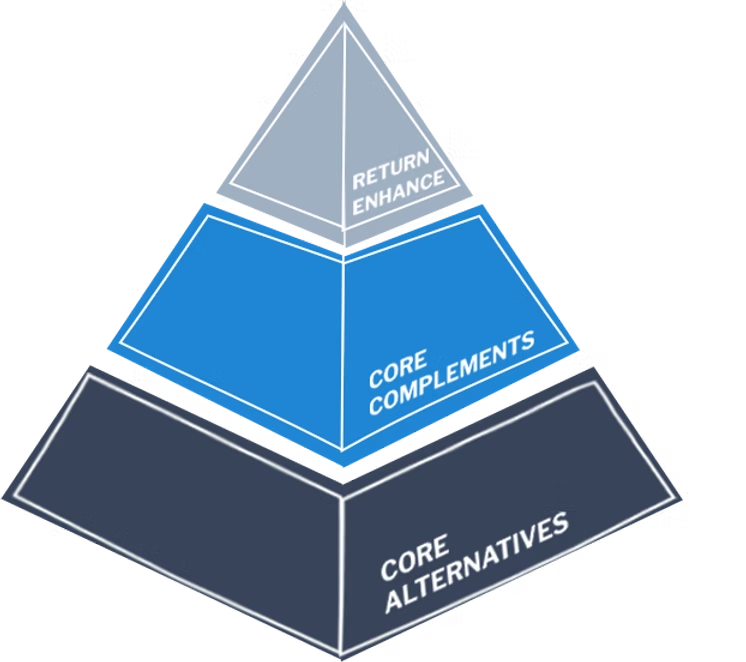
To demystify “alts”, we can start by breaking them down into three types: Core, Core Complements, and Return Enhancers.
Because of their often complicated structures, long investment horizons, and limited liquidity, we recommend an outcome-oriented approach: first identify the problem or investment need not readily met by traditional assets, then seek to identify which, if any, alternative asset class and structure is most appropriate.
Core
The foundation of an alts allocation: from fixed income-like private credit, to hybrid private-market core real assets offering steady income and some appreciation, to more equity-like low-vol and real asset strategies. Core alts can potentially be higher-returning substitutes for traditional fixed income and equity.
Core Complements
Hedge funds and other real assets that complement the core, diversifying return drivers beyond stocks and bonds.
Return Enhancers
Higher risk/reward private equity and distressed strategies, used selectively to further diversify the alts allocation and provide for more resilient long-term outcomes than core alternatives alone.
Please read the risk disclosure: alternative investments involve illiquidity, long horizons, and risk of loss, and are not suitable for all investors. See the disclosures below and our Form ADV Part 2 before considering any alternative investment.
Important disclosures
- Projections are hypothetical. Financial plans, Monte Carlo simulations, and scenario analyses are illustrative tools based on assumptions about the future. They are not predictions or guarantees, and actual results will differ, possibly significantly.
- Optimization scenarios are illustrations. Portfolio optimization examples show an approach to managing exposures; they do not represent the performance of any actual account and should not be read as a promise of reduced risk or enhanced return.
- Alternatives carry distinct risks. Alternative investments are often illiquid, involve long investment horizons and complex structures, may not be suitable for all investors, and some are limited to investors who meet eligibility requirements. You could lose some or all of an alternative investment.
- Past performance does not guarantee future results. All investing involves risk, including the possible loss of principal. No strategy, including asset allocation, diversification, or quality-focused investing, assures a profit or protects against loss.
- Not tax or legal advice. Split Creek Capital does not provide tax or legal advice. Coordinate with your CPA and attorney on decisions with tax or legal consequences.
- Registration is not an endorsement. Registration with the U.S. Securities and Exchange Commission as an investment adviser does not imply a certain level of skill or training, and the SEC has not approved or verified the content of this website.
- Read the official documents. Before engaging us, review our Form ADV ↗, Form ADV Part 2 Brochures ↗, and Form CRS ↗, which describe our services, fees, and conflicts in full.